Industries → Public Sector
Public Sector
From applicant management to grant processing: we build processes for public authorities that stay fast, traceable, and legally sound — even at high case volumes.
What makes this industry unique
Few environments are as demanding as public administration: strict procurement rules, the highest requirements for data protection and traceability, and processes that have to work reliably for millions of citizens. This is exactly where we want to show that innovation in public administration is possible — not as the exception, but as the result of solutions built together with the people who use them every day.
Customer voice
Dr. Jan Mütter
Head of Business Unit B, IT Base Components, Landesbetrieb IT.NRW

What we do there
We digitalize business-critical administrative processes end to end — from application and approval procedures to applicant management and budget, treasury, and accounting operations. Auditability, data protection, and traceability are not bolted on afterwards; they are part of the architecture from day one. And because public IT investments have the greatest impact when they are reused, we design solutions to be reusable beyond the individual agency — state-wide and nationwide.
References in this industry
Public Service
Rethinking Applicant Management (ePM.SAX/BMS)
A process spanning many stakeholders -- now seamless and fully documented end to end.
Public Service
COVID-19 Emergency Aid
Ready to accept applications under maximum time pressure, for 300,000 applicants.
Public Service
Low-Code Competence Center
Reusable building blocks made usable across department boundaries.
Public Service
Administering Fiscal Estates
A complex, heavily regulated workflow supported end to end.
Public Service
COVID-19 Bridging Assistance
Over 120 applications, 16 federal states, delivered as a subcontractor.
Public Service
A state-wide platform for electronic incoming invoices.
Free State of Saxony: Rethinking Applicant Management (ePM.SAX/BMS)
Public Service
Results
% kürzere Verfahrensdauer
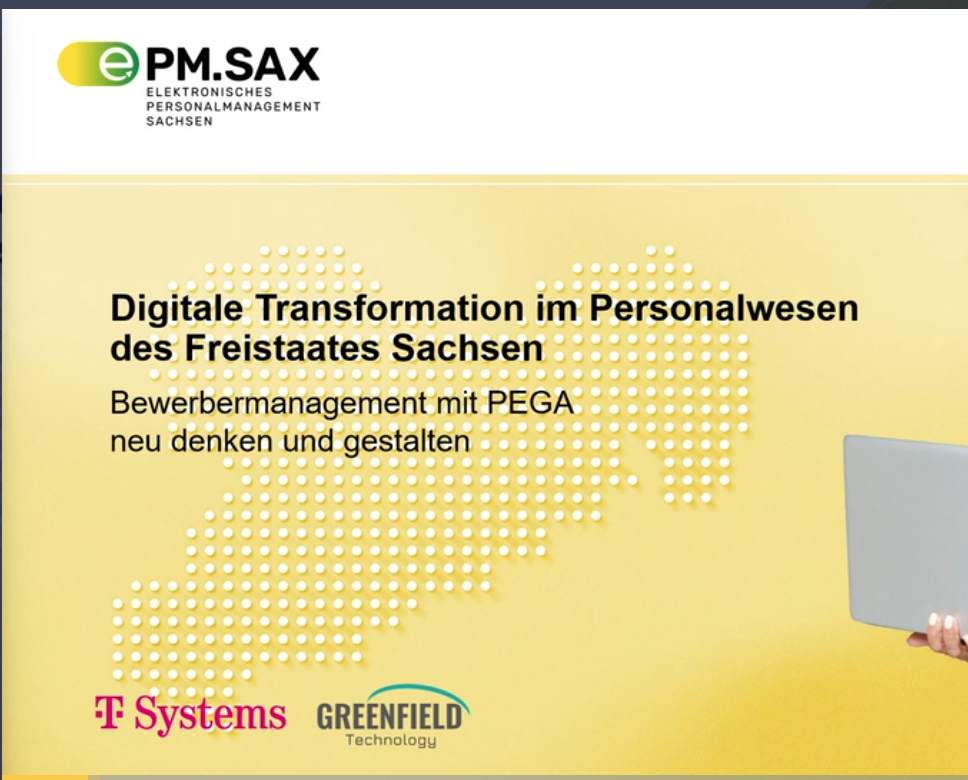
Presented publicly at the Pega Community Forum 2024 by Tobias Frick, Saxon State Chancellery.
The situation
In the large-scale ePM.SAX project (Electronic HR Management Saxony), there was previously no digital representation of application processes across Saxony’s state government. The application process is a complex one that also varied between individual authorities — the central task was to translate heterogeneous as-is processes into standardized to-be processes while involving every stakeholder: HR department, specialist departments, and staff councils across all pilot authorities.
The solution
Since 2023, the Free State has been developing the Applicant Management System (BMS) as a sub-project of ePM.SAX — delivered in an agile Scrum process using Pega’s low-code approach. Implementation was carried out jointly by Greenfield and T-Systems; Pega provides the platform. In a structured approach, as-is processes were first captured through stakeholder interviews and workshops, from which model processes (standard applications and applications for senior civil-service roles) were defined together with department representatives, and finally the to-be processes were developed in the Scrum team together with four pilot authorities.
Implementation proceeds across several releases: the main process (release 1), extension to subordinate authorities (release 2), and ongoing development (release 3 onward) expanding reporting and linking to the Federal Employment Agency. The guiding principle was to deliver usable results early and involve users from the very start. Through the application, authorities now handle every step digitally — from job posting through applicant review and assessment to interview scheduling and hiring.
Public reference - Pega Community Forum 2024

Bavarian State Ministry
Public Service
Results
Tagen
Tausend Antragstellende
Mrd. € abgewickelt
The situation
During the COVID-19 pandemic, a relief program for solo self-employed people, freelancers, and businesses had to be made available at extremely short notice. The first version, a plain PDF form, led to a flood of error-prone, handwritten applications.
The solution
Under intense political time pressure, the digital application journey was built and launched within five days — in close collaboration with Pegasystems. Several expansion stages followed: a caseworker portal, automated fraud detection with its own portal for investigating authorities, treasury integration, an interface to the tax offices (ERIC), and later a repayment-installment management module.

Low-Code Competence Center | IT.NRW
Public Service
Results
Cross-department reuse instead of repeated duplicate development.
The situation
A state-wide low-code initiative risked splintering into one-off solutions per authority instead of systematically reusing components that had already been built.
The solution
A clearly defined, Pega-based low-code approach with governance structures and a central overview of reusable components — from the planning phase through sustained delivery, established as the central point of contact for all low-code matters.
Why it matters
Reuse is the lever that truly scales public IT investment — a solution built once and deployed many times changes the cost-benefit equation of entire digitalization programs.
Presented together with Greenfield at the Pega Community Forum 2024 - by Gordian Bartel, Principal System Architect.

NRW Ministry of Finance: Administering Fiscal Estates
Public Service
Results
One end-to-end process instead of scattered individual steps.
The situation
Estates with no legal heirs were previously handled inconsistently, mostly on paper, across several administrative districts — with manual deadline and creditor management.
The solution
A low-code specialist application that unifies and automates form letters, deadline management, creditor settlement, and the systemic transfer into the public register of estates.
Why it matters
Complex legal administrative procedures can be standardized without losing professional diligence — a pattern that applies far beyond estate administration.
Federal Government
Public Service
Results
Wochen
Applikationen
Bundesländer
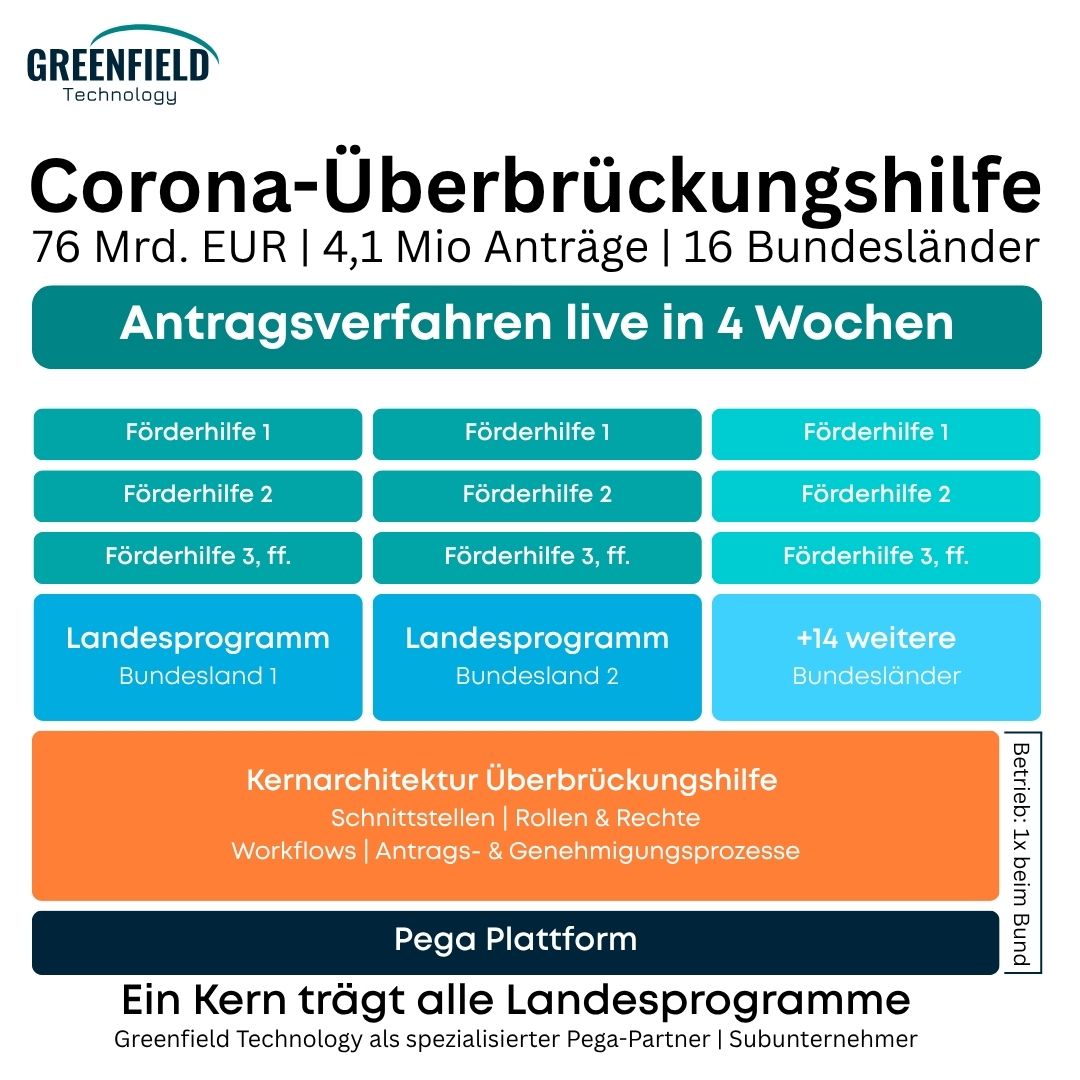
According to official BMWE figures, the overall program processed EUR 76bn across 4.1m applications.
The situation
In spring 2020, the federal government had to provide a digital application and approval process for businesses in the COVID-19 crisis at extremely short notice — nationwide, under intense political time pressure, with continuously new programs and state-specific special rules.
The solution
Built on the Pega platform, a fully digitalized end-to-end process emerged — from application through approval to payout. Instead of 16 separate state-level solutions, a shared core architecture carries every program: each federal state operates its own specialist procedures and review processes as its own layer on a shared foundation. This let states roll out programs with their own special rules within a few weeks, because the core was already in place and proven.
As a specialized Pega partner, Greenfield was involved as a subcontractor in development and delivery — providing specialist Pega consulting, leading business-architecture and development teams, and building fraud detection along with the highest possible level of straight-through processing. The general contractor was ]init[ AG, on behalf of the federal government.

Public Service
Results
The situation
Paper-based standard processes caused a high administrative burden, while an EU requirement mandated the introduction of electronic incoming invoices.
The solution
A state-wide platform with Pega as the central entry point, connected to existing core systems, with automated invoice validation and end-to-end status transparency.
Why it matters
EU requirements for electronic invoicing are binding on every public authority — building a scalable solution early avoids rework under time pressure later.