Portfolio → Why Pega
Portfolio Overview
We deliberately specialized in a single platform — because Pega masters exactly what matters in regulated, long-lived, and complex systems. The more complex the requirement, the bigger the advantage.
Five reasons
A platform is only as strong as the people who master it. And Pega shows its strength exactly where things get difficult: high case volumes, many stakeholders, multi-stage workflows, and strict regulatory requirements. Our specialization -- exclusively Pega, since 2018, across roughly 500 projects -- makes sure that advantage actually reaches the project.
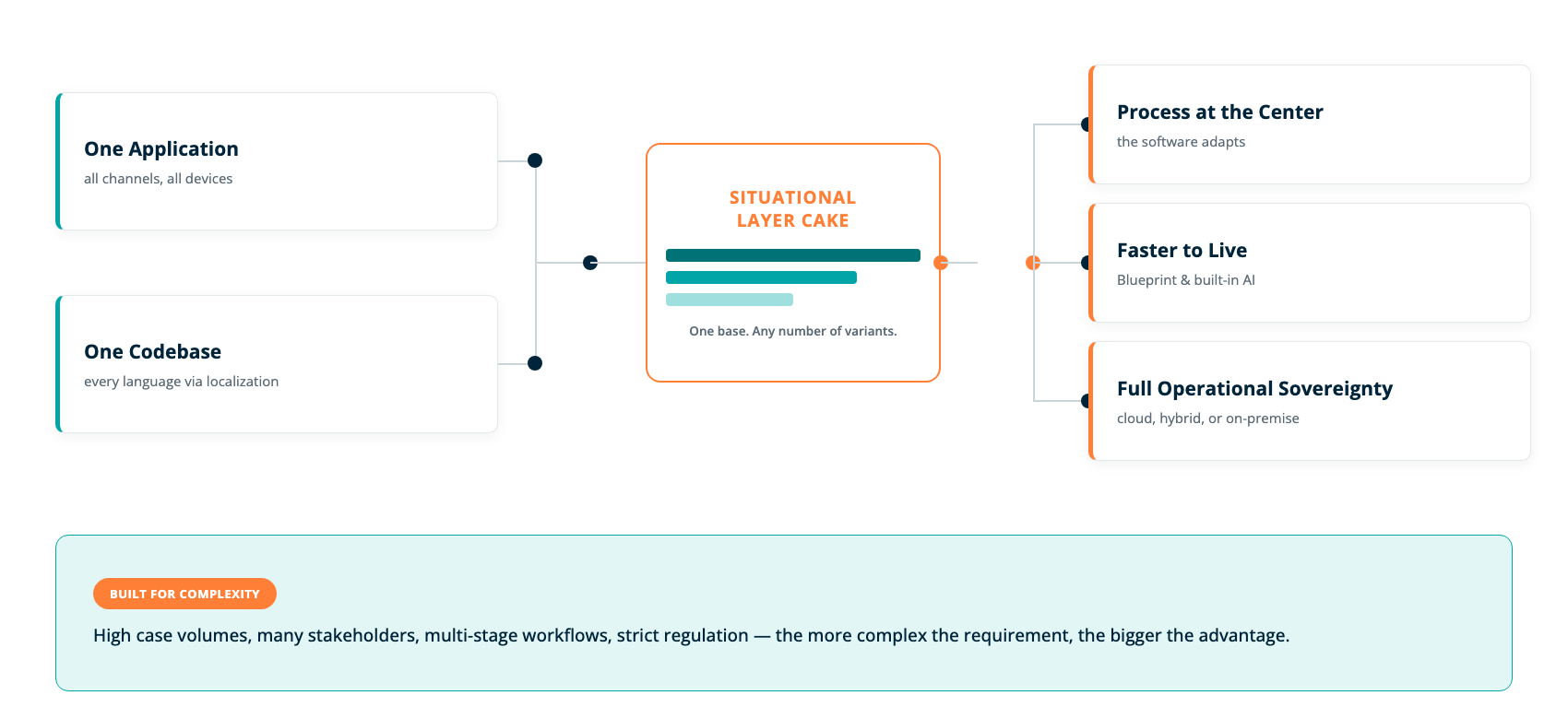
With Pega, an application is built once -- and is simultaneously available on every device, from desktop to mobile, with no separate development effort. Localization follows the same principle: the same application is translated into any language the client needs, without duplicating the business logic.
Pega doesn't build applications as isolated copies, but as layers that inherit from one another. A shared base carries the business logic; layers for individual tenants, regions, or regulatory variants sit on top of it. If something fundamental changes, it's adjusted once at the base and takes effect everywhere -- if something local changes, it stays confined to its own layer. For organizations with many agencies, locations, or subsidiaries, that means maintaining one base instead of ten nearly identical applications.
Pega thinks from the customer outward: the customer journey is modeled centrally -- across every channel and every language. It's not the customer who adapts to the software, but the software that adapts to the process. That's the decisive difference from off-the-shelf software, where organizations have to adapt their workflows to the system's limits.
Tools like Pega Blueprint and built-in AI speed up development substantially -- according to Pega, by a multiple compared to classic Java development.
Business-critical, regulated processes often require that data and operations never leave the organization. Pega runs with its full feature set wherever requirements demand it -- in the cloud, in your own data center, or hybrid. The operating model and data sovereignty follow the client's requirements, not the platform's limitations.
Sovereignty
Digital sovereignty is often discussed as an all-or-nothing question: either complete independence from US technology, or no engagement with the topic at all. That's the wrong question. Complete isolation is neither realistic nor the goal of the current debate -- even the EU doesn't talk about self-sufficiency, but about control and the ability to act in a crisis. The real question is: how far can the risk be reduced without jeopardizing operations?
With Cloud, EU Service Boundary, and client-managed operation, Pega today offers several options. The right choice depends on the criticality of the specific system, not on a blanket decision for the entire IT landscape. Most of our clients run their systems themselves -- and we remain a partner there too, not just during implementation: we support architecture decisions, system sizing, and ongoing application management, regardless of where and how an application ultimately runs.
We don't pull Pega container images and Helm charts live from the vendor on an ongoing basis -- instead we review, harden, and version them in our own repository. The result: no deployment depends on an external download at runtime, every software component is vetted, and every operational state is fully auditable.
Whoever negotiates only once an emergency hits negotiates from a weaker position. Three instruments settle this in advance: survival clauses secure the right to continue using existing deployments even after the contract ends. Escrow agreements with extended release triggers secure access to the source code not only in case of insolvency, but also if a vendor is no longer able to deliver for other reasons. And exit clauses define upfront what an orderly transition looks like, instead of negotiating it anew in a dispute.
We stay technology-agnostic: depending on the requirement, we deliberately use European language models such as Mistral -- for instance where data sovereignty is the priority -- just as we use other leading models when the task calls for it. Not binding yourself to a single provider keeps you able to act if a provider changes or fails, and lets you choose the right model for each task.
In the end, what matters less is your general stance on sovereignty than the sum of the architectural decisions you make today.
Architecture carousel
Low-code differentiation
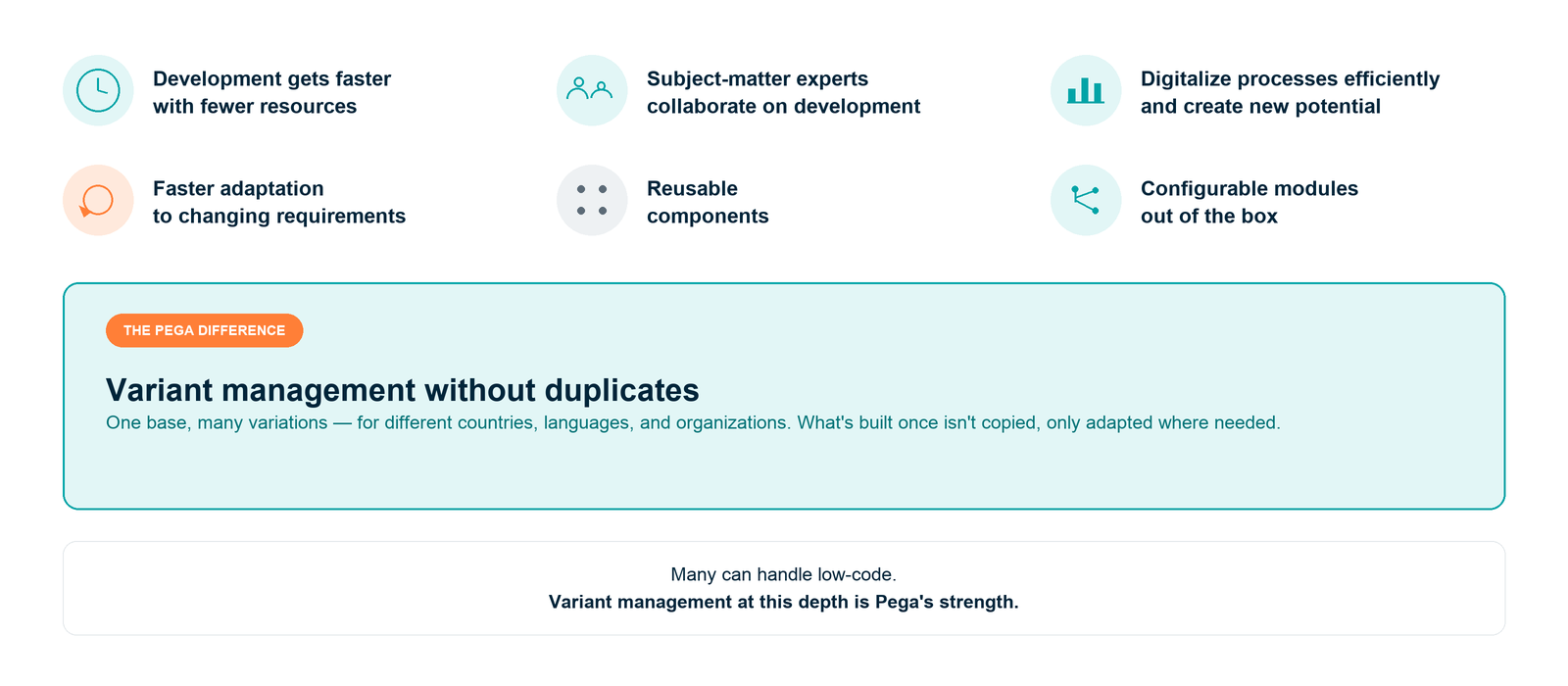
The classic low-code benefits are generic arguments — virtually every platform offers them. The real difference lies in variant management without duplicates: modeling countries, languages, and organizations on a shared base instead of maintaining a separate application for every variant. That depth is exactly where Pega sets itself apart from other low-code platforms.