[weglot_switcher]

We are exhibiting | Booth No. B004

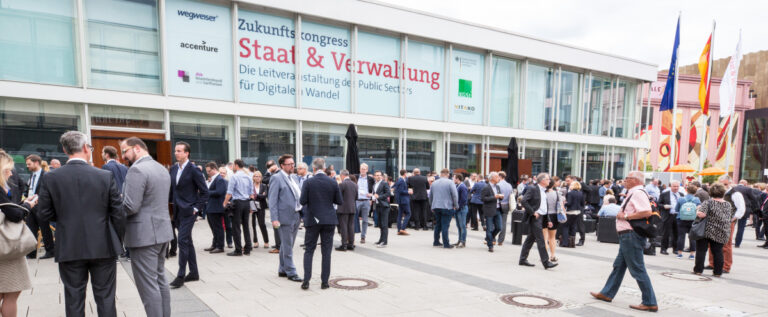
12th Future Congress Public Sector & Administration
June 9-10 | Berlin

Why the Future Congress is relevant to us

Administration needs implementation power – not just reform debates

The Zukunftskongress Staat & Verwaltung 2026 (Future Congress for State & Administration) focuses on the efficiency of the state and public administration. For Greenfield, this is a crucial point: a modern state is not created solely through new strategies, reform programs, or pilot projects.

What counts is the ability to effectively implement digital solutions within complex administrative structures—securely, scalably, and compatibly with existing systems.

Cultural change alone is not enough. Administration needs a consistent focus on performance and impact, aligned with the actual needs of citizens and the economy.

This is precisely where Greenfield sees a central lever: digitalization must provide measurable relief. It must simplify processes, reduce media discontinuities, integrate specialized procedures, and support employees in their daily administrative work.

As an exhibitor at the Future Congress, we want to discuss exactly this: How can digital transformation in administration succeed not just as a concept, but as a viable solution in everyday practice?

Our perspective: administrative digitalization becomes successful when strategy, technology, expertise, and operations are considered together from the very beginning.

Topics that truly move administration forward

The Future Congress addresses key fields of action that are also particularly relevant to our work at Greenfield. We focus primarily on topics where digital transformation does not remain abstract but must unfold a concrete impact.

Public IT, digital infrastructure & data sovereignty

The modernization of public IT is a basic prerequisite for a high-performing administration. Topics such as harmonized IT structures, cloud, digital identities, register modernization, cybersecurity, end-to-end digitalization, and low-code show that it is no longer just about individual digital services, but about sustainable digital structures.

For Greenfield, it is crucial that new solutions are not placed alongside existing systems, but are meaningfully integrated into existing IT landscapes. This is the only way to create digital processes that remain usable, maintainable, and scalable in the long term.

Future technologies in state and administration

AI, process automation, platform technologies, low-code, once-only principles, data protection, data regulation, and digital sovereignty are among the central future topics for administration.

However, the decisive point is not the technology alone. What matters is how it is used responsibly, transparently, and practically.

Especially for AI-related applications and automation, clear governance, secure architectures, and processes that are both functionally and technically robust are essential.

Low code can make an important contribution here: not as a shortcut without structure, but as a way to implement complex requirements faster, in a more controlled manner, and with greater adaptability.

Leadership, management & collaboration

Modern administration needs not only new technologies but also clear management. Many digitalization projects fail not because of a lack of ideas, but because of silo thinking, unclear responsibilities, or a lack of connectivity between expertise, IT, and operations.

That is why leadership, collaboration, and a shared understanding of impact are crucial. Digitalization must be thought of across departments, levels, and organizations—with clear goals, transparent processes, and solutions that can actually be used in everyday life.

Future tasks of the administration

Whether it’s planning and approval procedures, digital procurement, modern legislation, internal security, or citizen participation: many future tasks of the administration are heavily process-driven.

This is exactly where it is decided whether digitalization has an impact. It is not the interface alone that makes administration more modern, but the ability to map complex workflows consistently, transparently, and efficiently.

For Greenfield, these are precisely the fields of activity where platforms like Pega, low-code approaches, and process automation can demonstrate their strengths.

From the idea to a viable digital solution

Many digitalization projects do not fail due to a lack of ideas. They fail due to implementation within existing systems.

Specialized procedures are complex. Responsibilities are distributed. Requirements change. At the same time, data protection, security, traceability, accessibility, operational safety, and long-term maintainability must be guaranteed.

That’s why it’s not enough to develop digital solutions quickly. They must also fit into existing structures, be functionally viable, and be capable of being operated and further developed in the long term.

With our Pega expertise, Greenfield supports organizations in digitally mapping, automating, and continuously optimizing complex administrative processes.

This is not about digitalization for its own sake. It is about solutions that provide concrete relief for administrative work:

fewer media discontinuities, clearer workflows, better traceability, higher scalability, and more relief for the people who work with these processes every day.

On-site exchange: Greenfield at booth B004

  • End-to-end digitalization of administrative processes
  • Low-code as an accelerator for complex specialized procedures
  • Process automation in existing IT landscapes
  • AI-related applications with clear governance
  • Digital sovereignty and secure platform architectures
  • Modernization and integration of existing specialized procedures
  • Operation, maintenance, and continuous development of digital solutions
  • Scalable implementation instead of isolated pilot projects


The last point in particular is central: administrative digitalization must not get stuck in individual projects. The decisive factor is whether solutions work beyond pilot status—in operation, in scaling, and in daily application.

This requires technology, functional understanding, and implementation experience. This is exactly what Davina, Ralf, and Olav want to discuss at the Future Congress.

📍 Booth B004
📅 June 9–10, 2026
📌 bcc Berlin Congress Center

More highlights for you

Experienced. Competent. Reliable.

Competence centre for secure and scalable Pega solutions – COE consulting stands for Center of Excellence. It is a competence centre or a community of practice for governance and maintainable Pega architecture. COE plays a central role in optimising and standardising IT processes and technologies within a company.

The COE’s main task is to develop best practices and ensure that IT initiatives are efficient, secure and scalable. Typical tasks include:

  • Enterprise architecture & development operations
  • Pega installation & upgrades
  • Monitoring via predictive diagnostics (cloud & Grafana, Prometheus, etc.)
  • Infrastructure topics (SSL/TLS, firewalls, database access)
  • Training & development of new employees & new technologies

Standardised. Integrated. Efficient.

With us, you not only implement Pega’s popular low-code platform reliably, but also benefit from many other advantages such as our continuously growing portfolio of universal components. These Greenfield Components can be used across industries and solve your typical challenges in process management or customer service.

Learn more about Greenfield Components and their functions:

  • Address validation – Automatically corrects and supplements addresses.
  • Case archiving – Archives data flexibly and at scale
  • DIN letter – Creates standards-compliant, customised letters
  • Payment validation – Checks and supplements payment data
  • QR code – Automatically generates and integrates QR codes
  • WhatsApp – Uses the well-known chat app for customer communication
  • Service Compass – Displays customer data and history clearly
  • File Conversion – Converts files automatically
  • AI Component – Integrates AI-driven text processing and document analysis in a GDPR-compliant manner

Targeted. Practical. Sustainable.

Would you like to reduce unnecessary costs for services and customisations by external service providers in your Pega projects? Then become an expert yourself and take the necessary customisations into your own hands in the future. Whether Pega Citizen Developer, Business Architect or System Architect, they all take on different roles and functions.

We help you meet these requirements and train you in the Pega skills that matter to you. Choose between Qualified, Advanced and Professional courses and decide for yourself the desired intensity and implementation of your training.

Together, we integrate the latest innovations and bring the skill set into your team that your organisation truly needs.

Did you know? Did you know? We regularly publish new and exciting articles on AI and digitalization with low-code. We highlight current trends, innovative technologies, and practical use cases. Learn more on our blog and stay up to date with digital transformation.

Greenfield Blog

More current and exciting articles

We keep you informed! Read here about current industry trends and the latest insights from Greenfield.

Stay in touch with us

You can find us on LinkedIn under "Greenfield Technology"

Or take the opportunity to contact us via the usual channels.