



Many organisations have already invested in test automation.
Frameworks are in place, tests exist, and reports are generated.
And yet, the same situation keeps occurring before releases:
Not because there are no tests — but because no one can say with certainty what they actually safeguard.
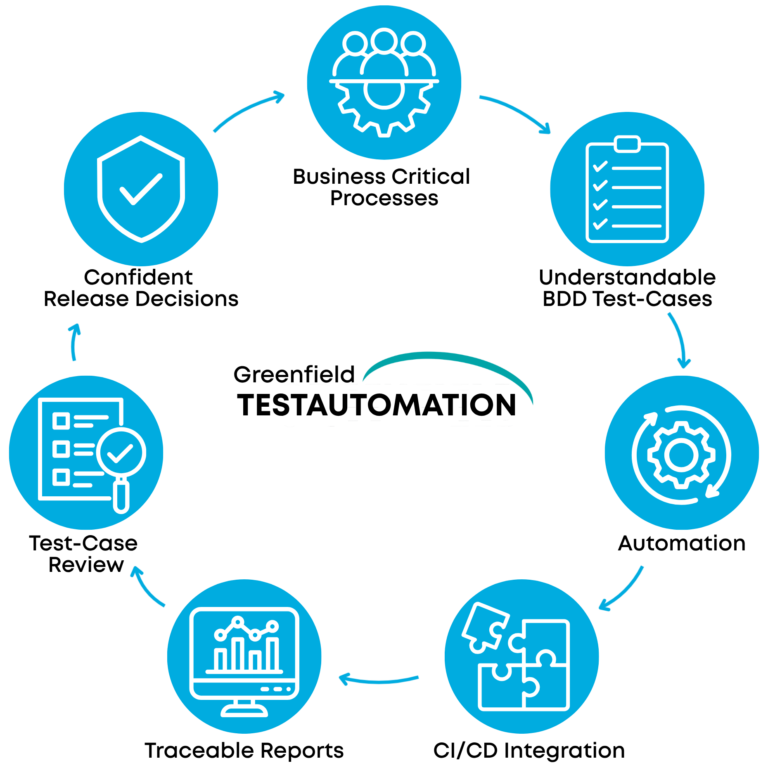
We do not start with tools, but with the questions that are truly decisive in projects: Which processes are business-critical, where do real risks arise, and which tests deliver real value? Only on this basis can test automation be created that not only works technically, but also reliably supports day-to-day project work.
We use Behavior-Driven Development (BDD) with Gherkin syntax to map business requirements directly into test scenarios.
This creates end-to-end traceability between business logic, requirements, and automated tests.
By using the Screenplay Pattern, we clearly separate test logic, interactions, and business workflows.
This enables modular, reusable test components and reduces maintenance and adaptation effort in the long term.
Test automation is fully integrated into CI/CD pipelines (e.g., via build triggers, automated test runs, and artifact generation).
This turns quality assurance into a continuous process across the entire delivery pipeline.
With structured reporting (e.g., Serenity Reports), test results become traceable and requirements are clearly assigned.
This creates auditability and enables well-founded decisions based on reproducible results.
Test automation is understood as an ongoing part of operations and is actively developed further.
With clear role models, versioning, and infrastructure integration, the setup remains stable and scalable even as complexity grows.
Test automation is well established—but the crucial confidence is often missing before release.
This white paper shows how test automation becomes a reliable basis for decision-making.
Practical, structured, and based on real enterprise projects.
For everyone who no longer wants to base releases on uncertainty.

The result is more than just working test automation:
It creates a reliable foundation for quality, stability, and well-founded decisions.
This is how test automation is created that you can rely on when it matters most.
Pega Authorized & Specialized – proven expertise in regulated industries. We stand for quality, transparency, and reliable delivery.

Everything decision-makers and IT want to know about our test automation – concise, easy to understand, and technically sound.
We see this very often.
In many projects, tests exist — but they do not provide a clear basis for decisions.
Typical reasons:
This is exactly where we come in: We ensure that test automation becomes understandable, attributable, and reliable.
The key question is not how many tests exist — but rather:
Can you confidently approve a release today based on the tests?
If the answer is not clearly “yes”, what is usually missing is:
We help you assess this objectively and make it visible.
Yes — and in practice, that is the norm.
We do not work with a “rebuild from scratch”, but instead:
The goal is not perfection — but tangible improvement in ongoing operations.
A clear indicator is:
Less coordination before releases — more clear decisions
If instead you see:
…then the real benefit is missing.
👉Good test automation reduces exactly this friction.
If quality, releases, and stability already work reliably: probably not immediately.
But if:
…then now is exactly the right time to address this in a structured way.
Gherkin is a structured, easy-to-understand language for describing test scenarios in test automation.
It is based on the Behavior-Driven Development (BDD) approach and uses a clear syntax with the keywords:
This format makes it possible to define requirements and tests in a shared language — understandable for business, IT, and quality assurance.
Using Gherkin offers several advantages:
Especially in complex or regulated system landscapes (e.g., public authorities, insurance, or healthcare), this approach ensures that test automation does not work in isolation, but can be used as a reliable basis for decisions.
In practice, it becomes clear:
The real value does not come from the syntax itself, but from building tests in a structured, understandable, and maintainable way over the long term.
Use our contact form, and we will gladly address your request individually.